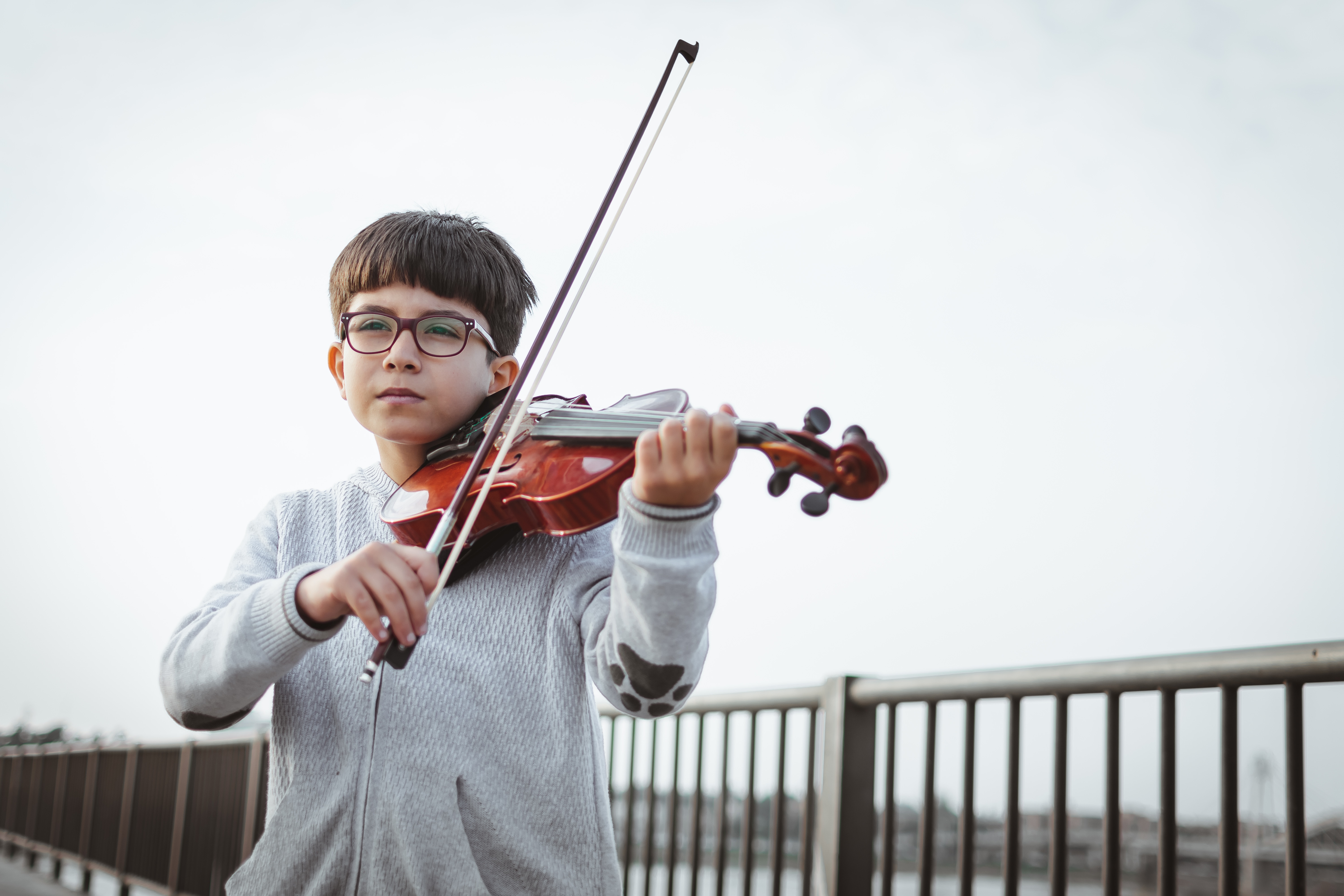
As parents who help our children practice, we do not want to watch every moment of the process forever. After all, the purpose of practicing alongside them is to reach the point where we no longer need to: children should gradually develop their own habits.
But while helping my child practice, I have noticed several routine requirements that children tend to “forget” whenever we stop paying attention. Parents need to remind them often.
1. Not Singing Through the Score
Generally, when students begin a new piece, teachers ask them to sing through the score first. Singing the score is a basic step in practicing a piece.
How important is it? The following explanation comes from a music teacher:
- We sing through the score first because doing so helps us learn not only the note names but also the piece’s key—the sharps or flats after the treble clef at the beginning of each staff are an important indication of the key—and the accidentals in the score.
- Always keep the beat as you sing, preferably with a metronome running. This helps us form an accurate, clear mental sense of each note’s duration.
- Once we have identified the notes and beats correctly, we begin combining individual notes into short phrases in the correct rhythm, then sing them until they are familiar. The piece begins to take shape in our minds.
- Once the phrases are familiar, we can sing them together. The “score” has now become “music” in our minds. With a sense of the music, playing it becomes less complicated because we know exactly what we need to do: which notes and rhythms to play.
- One very, very important benefit of becoming familiar with singing the score is learning to “prepare ahead.” The violin is indeed a very difficult instrument to learn. From the beginner stage, teachers start developing students’ ability to “keep the mind ahead of the hands.” Put simply, while you are playing one note, your mind must immediately identify the next one and get your fingers ready accurately in advance. This sounds difficult, but if we can sing the score fluently and practice slowly with a little more patience, the teacher says we can develop this ability quickly and benefit from it throughout our lives.
Children tend to pick up the violin and start playing immediately rather than make the effort to sing the score.
To prevent this, my child’s violin teacher sometimes gives very specific instructions: “This week, only sing this passage at home. Do not practice playing it. Record yourself singing it and send me the recording.” With such clear requirements, it is harder to take shortcuts.
Why are children so reluctant to sing the score first?
My understanding is that it is less fun than playing the violin and feels more boring. It also requires real mental effort to analyze the notes and phrases carefully and become familiar with them. As the explanation above says, singing the score turns written notation into “music.” That is actually quite demanding.
It seems to me that relatively few parents recognize the importance of singing the score. We need to understand it ourselves and remind our children more often.
2. Not Using the Metronome
The metronome should accompany practice throughout the process.
My child’s violin teacher asks us to use it at all times. I have also read the following words in Music at Your Fingertips, a book by a master musician. Here they are translated from the Chinese quotation in the original article:
The metronome is an essential tool for practice. I always recommend that musicians use a metronome in their practice throughout their lives.
Yet I still often have to remind my child during practice: “Turn on the metronome.”
I see two reasons why children sometimes practice without it.
- They really do forget. It has to be switched on before practice, then switched off during interruptions or breaks because it can be noisy. A mechanical metronome also needs to be wound regularly to keep it running. It is genuinely a little inconvenient.
- Practicing with a metronome adds pressure. Once it is running, the child has to work to stay with the beat. That pressure can be considerable, especially when the child is not yet comfortable playing the piece at the chosen metronome speed.
If you identify the second reason as the problem, ask your child to lower the tempo and practice at a speed where keeping up is less of a struggle.
Disclosure of interest — a plan reported in the original September 2017 article for the China-market Violy app: The author said that Violy would add a built-in metronome in the future to remove the inconvenience of a separate one. As described in that plan, the metronome would start automatically when practice began and stop when practice ended. This was a plan at the time of writing, rather than a statement of current Global app functionality.
3. Speeding Up
For a new piece, teachers ask students to practice slowly first. The purpose is to learn every note and every detail accurately. As long as it is accurate, there is no such thing as too slow.
Playing faster inevitably makes the physical movements more demanding. A faster tempo can mask places that have not been mastered at a slow speed. Each increase in speed places greater demands on the movements and introduces a new level of difficulty.
Accuracy at a slow tempo must come before speed. Otherwise, even if a child quickly manages to play “fast,” the result will be a mess of mistakes. Worse, the incorrect parts may become familiar through repetition, requiring even more time to correct. As the saying goes, haste makes waste.
I suspect this is another sign of wanting quick results. Children tend to hurry toward a faster tempo rather than first work carefully on every note and detail. When they do increase the speed, they also tend to push too hard: they have only just managed a tempo of 40, and their next step is to try 80.
Parents often need to “put on the brakes” and remind their children: slower, slower. Increases in tempo should also be gradual, a little at a time.
4. Not Practicing in Sections
When practicing a piece, we should divide it into several short sections, work on each separately, and then gradually connect them. This is a general approach to all kinds of tasks. I remember that even simple movements such as standing at attention and standing at ease during military training at school were broken into smaller actions for practice.
Usually, the teacher helps us mark the sections. Sometimes we need to divide them ourselves according to the child’s level and progress with the piece. Most often, a section is about two lines long.
But even when the teacher has clearly marked the divisions, children tend to practice several sections together instead of first getting each short section good enough on its own and then joining them.
The right approach is to bring each section up to the required standard separately before combining them. We do not necessarily have to work through the sections in order; we should organize practice around the most important and difficult parts. Those sections should come first, rather than rushing to achieve the effect of playing everything together.
I think this problem arises because children want quick results and focus more on playing the whole piece than on accuracy.
In my view, “not practicing in sections” is the most important of these problems!
Yet in conversations with many parents, I have found that they do not give it enough attention. They let their children play a piece from beginning to end, treating a few complete run-throughs each day as a finished practice session.
Disclosure of interest — the author’s account of Violy in China in September 2017: At the time, the author reported that many people were using Violy every day and that practice data could be viewed in the app’s administration system. “We noticed a problem: quite a few children were working hard on a piece and practicing it repeatedly for a long time, but without clear improvement. Their scores remained low, around 60 or 70. Looking more closely, we found that each individual practice attempt was very long. This is the key reason for inefficient practice! In my own family, my basic requirement is that my child score above 85 on one section before moving to the next. When several sections are joined together, if the score has not reached 80, we go back to practicing them separately.”
5. Always Starting from the Beginning
Practice has a basic principle: break things down and focus on the important and difficult parts.
When my child practices, she always likes to start at the beginning and play through to the section she is currently working on. My explanation is that the opening is the part she knows best, so playing it gives her a sense of achievement.
But practice time is always limited. When every attempt begins at the start, the opening sections get rehearsed until they are known inside out, while the later sections receive only a limited share of the time. A particular passage may be the difficult part of the piece. If it is never practiced on its own, it remains the piece’s weak spot.
The right approach is to treat a piece as several short sections throughout practice. Until each section is reasonably well practiced on its own, do not allow them to be connected and treated as a whole. Work out each short section separately, and spend more time examining the difficult ones.
Children generally do not have adults’ rational approach. They tend to avoid difficulties and pick the easy, appealing fruit. Parents helping with practice need to remind them of this often: analyze the piece rationally, identify the hardest and least familiar parts, and work on those sections—or even individual measures—first.
To sum up, the main reason behind these recurring problems is usually the desire for quick results. Parents themselves often fall into the same trap. That means we need to overcome it together. Keep reminding yourself: haste makes waste!