The scenes and recollections below follow the source article’s narrative account.
Outside that door.
Thirteen-year-old Anne-Sophie Mutter sat waiting, her violin case resting against her knees.
Through the door, she could hear the orchestra rehearsing.
Sometimes there was a great sweep of strings. Sometimes it suddenly stopped, leaving only a man’s voice.
She looked down at her hands.
Inside that door.
There was a man who reigned over the music world like a figure out of legend. His name appeared on record covers and brought a sudden seriousness to adults’ faces when they talked about music.
The door opened. Someone called her name.
She took a deep breath and straightened her back. However difficult a passage was, she could learn it through practice. But no one had taught her how to face Karajan.
She picked up her violin case and walked in.
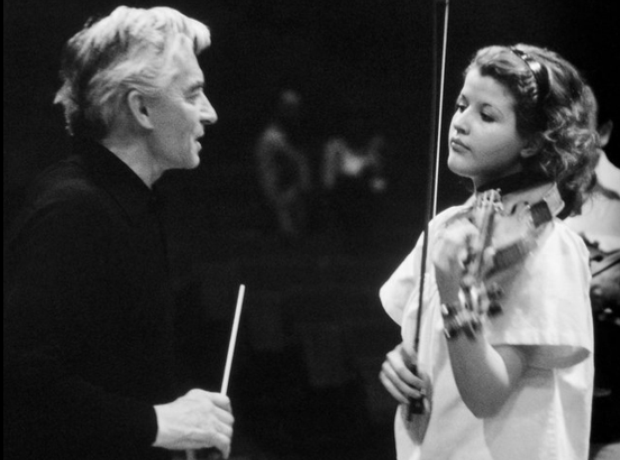
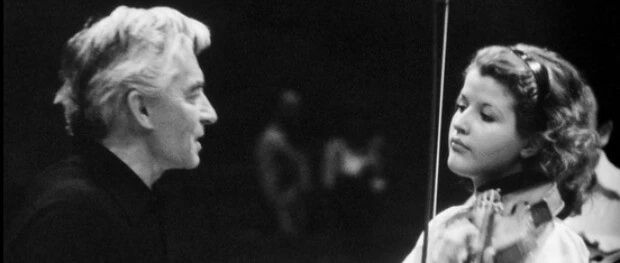
Mutter with Karajan in her younger years.
Karajan was busy that day. The rehearsal had just ended, and there was a performance that evening.
He had seen many gifted children.
They could play difficult passages cleanly and beautifully, their fingers moving with astonishing speed. The adults accompanying them were often more nervous than the children, as though they had packed the entire family’s future into that violin case.
The girl took her place.
Karajan signaled for her to begin.
At first, he heard the training: accurate notes, a steady bow, phrases practiced over and over again.
Then something made him lift his head.
She did not rush the melody toward the next note. Her bow slowed just a little, allowing the phrase to linger in the air.
In that small pause, there was something of her own to say.
Karajan watched her.
The girl kept playing. She did not know that she had made Karajan pause. The music had begun; she had to give it her undivided attention.
Gradually, the room grew quiet.
Someone stopped gathering up the sheet music. Chairs no longer moved. A day that had been about to end was extended a little by this child’s playing.
Mutter later recalled that Karajan, despite being pressed for time, let her play for half an hour.
Afterward, Karajan invited her to Salzburg to perform with him and the Berlin Philharmonic.
How did she celebrate the invitation?
Years later, a journalist asked her.
Her answer: she went straight to the zoo after playing.
That answer brings something back into focus:
the performer who had held Karajan’s attention for 30 minutes was still a 13-year-old girl with a child’s heart.
When she actually came to perform with the Berlin Philharmonic, things became more complicated.
The rehearsal room was full of adult musicians. They adjusted their instruments, turned the pages of their scores, and exchanged glances with an unspoken understanding that she had not yet learned.
She sat there in jeans, waiting.
The orchestra rehearsed other pieces first. Time passed. She had already played her opening in her head, then played it again.
At last, it was her turn.
The orchestra began the introduction. She raised the violin to her shoulder and waited for the moment to enter.
But Karajan stopped them.
He pointed out a small problem to the orchestra and asked them to start again.
That brief interruption loosened the tension in the room.
So even the Berlin Philharmonic could be stopped.
Even the people sitting here needed another try.
She adjusted her bow again.
When the introduction began for the second time, she no longer faced an imposing wall of masters. She began to hear sounds she could approach and answer.
The violin joined the orchestra.
Karajan raised his eyes and met her first phrase.
For a child, help can sometimes be just such a moment: letting her know that here, she can breathe.
After that, life began to move at a different speed.
Concert halls, recording studios, airports, hotels.
The violin case opened and closed again. A city that had been unfamiliar yesterday was already receding beyond the car window today.
In 1978, her recording of Mozart’s violin concertos with Karajan and the Berlin Philharmonic was released.
On the record cover, her young face appeared alongside that celebrated name.
More and more people came to know her.
When they introduced her, they always mentioned him, too.
“The girl Karajan discovered.”
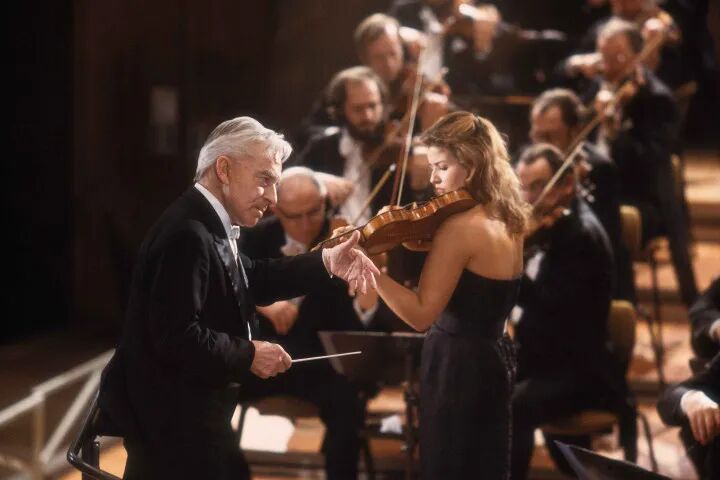
Mutter performing with Karajan. © Siegfried Lauterwasser / DG.
She gradually grew up.
At one rehearsal, she played a passage according to her own interpretation.
When her bow stopped, she looked toward Karajan.
In the past, she would have hurried to search his expression for a sign of whether she was right or wrong.
This time, she waited a moment, then tried to explain why she wanted to play it that way.
Her words did not come easily. Things that make sense in music often become awkward when put into language.
But she made herself clear, and her interpretation was accepted.
Day by day, she had moved beyond the age of 13.
In 1989, Karajan died.
Mutter later recalled:
at her first performance without Karajan, she stood in the wings.
She walked into the light, greeted the audience, and then turned toward the conductor’s podium.
Another figure stood there. From then on, she would have to find her own way.
She continued to play Mozart, Beethoven, and Brahms, while also bringing her bow to new works, many written especially for her.
People in the audience might know the sound of her Mendelssohn, yet have no idea what they would hear that evening.
After the applause died away, she would lead them into a new musical continent they had yet to discover.
Perhaps a title such as “Queen of the Violin” acquired its weight gradually, over countless evenings like these.
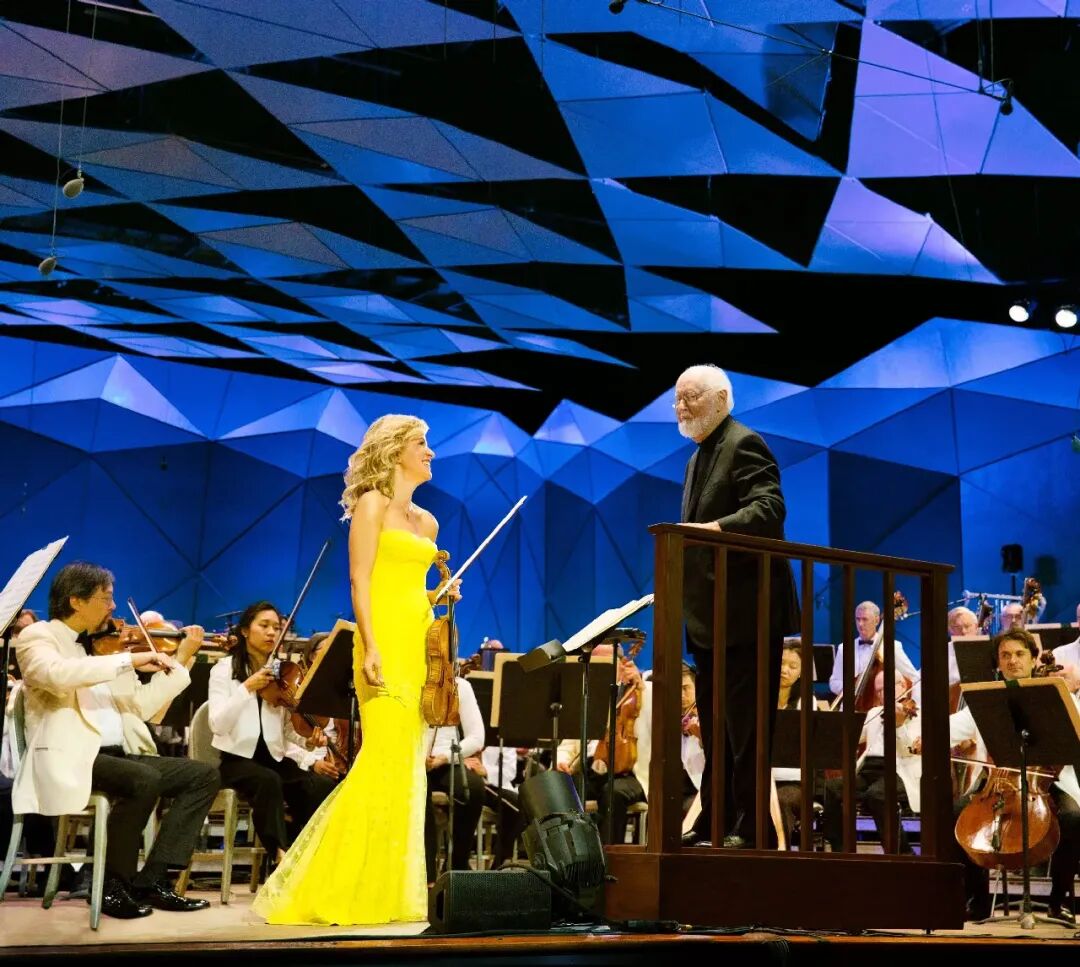
Mutter on stage.
In 2026, Mutter was marking her 50th anniversary on stage.
Even after four Grammy Awards, nine ECHO Klassik awards, and numerous other leading international honors, she remained at the center of the stage.
Translation correction: the original calls the nine awards “Classic Fm” awards. Mutter’s official biography identifies them as ECHO Klassik awards (rendered there in English as “Echo Classic Awards”).
The concert invitation, ticket giveaway, prices, and membership terms below are preserved from the original China-region article published on September 18, 2026. They describe that announcement and its local offers, rather than current Global services or benefits.
The article announced that on November 3, the “Queen of the Violin,” Mutter, would appear at the Guangming Culture and Art Center as the closing guest of the Shenzhen Belt and Road International Music Festival.
She would be joined by the renowned Royal Philharmonic Orchestra, which had been granted the title “Royal” by the British Queen herself.
The article described this as a rare opportunity to take your child to hear one of the world’s finest performers: every concert attended was an opportunity that would not come again.
Violy strongly recommended it!
The original invitation asked readers to leave a comment about their family’s experience with the Violy app and share the article. The two readers whose comments received the most likes would each receive one ticket. The comment deadline was September 22 at 15:00. Readers were instructed to contact Violy customer service to claim their tickets.
Ticket Information

2026 Shenzhen Belt and Road International Music Season
Anne-Sophie Mutter and the Royal Philharmonic Orchestra in Concert
Performance Time
Tuesday, November 3, 2026, at 20:00
Venue
Guangming Culture and Art Center
Grand Theater, Performing Arts Center
Duration
95 minutes, including an intermission
Ticket Prices
CNY 1680/1380/1080/880/680/480/280/100
Limited-Time Discounts
Tickets priced at CNY 1680/1380/1080 were offered at 20% off; tickets priced at CNY 880/680/480 were offered at 10% off.
Original prices: CNY 1680/1380/1080/880/680/480/280/100
Discounted prices: CNY 1344/1104/864/792/612/432/280/100
The limited-time discounts could not be combined with membership discounts.
Membership Discount Policy
Membership discounts were available, with a limit of six tickets for this performance.
Payment by stored-value card was accepted.
Birthday discounts were available, with a limit of four tickets.
For convenience when purchasing tickets, customers were asked to contact customer service representative Xiaoming to obtain the birthday discount. Its validity would be extended to 23:59 on the day after it was issued; expired discounts would not be reissued. Customers purchasing tickets for another performance or project needed to contact Xiaoming again for a new discount.
Scan the QR Code to Buy Tickets

Please Note
- Each person needed one ticket for one seat at this performance.
- Children under 1.2 meters tall were not admitted,
or children aged six and above needed to bring an identity card for admission.
Translator’s note: the original admission notice links these conditions with “or” and does not clearly explain how the height and age requirements interact. The conditions are preserved as written; readers should confirm their application with the venue.
Violy
The original article describes Violy as a specialist violin-practice tool founded in 2016.