
During our livestream for Singles’ Day (November 11) in China in 2026, the lights were bright and we were talking fast.
We were chatting to the camera as usual when a few simple messages from families slowed the stream of comments on-screen.
“Time flies. We’ve been using it for six years.”
“My child started using it when all they could play was open strings. They started middle school this year. It’s been seven years.”
We were reading those messages aloud and smiling when another popped up at the bottom of the screen. One parent said they’d known Violy for ten years.
The moment we saw the name, we froze, then blurted it out.
We knew it right away.
There was no need to look up an account record. One glance told us it was someone who’d been part of our WeChat group since the early days.
It took a moment for it to sink in.
Somehow, nearly ten years had passed since that winter in 2016.
How long is ten years?
Long enough for a child who could barely hold a violin under their chin and cried at the music stand while playing “Twinkle, Twinkle, Little Star” to move up to a full-size (4/4) violin and grow taller than both parents.
Long enough to go through six or seven generations of phones and pin one WeChat group after another, only to find some of the same people still there whenever you drop in.
Violy began with a small, painful moment of parenthood.
In the fall of 2016, in an ordinary living room in Shenzhen, our founder, Javen Fang, was helping his daughter practice the violin.
If you’ve ever sat with a child through practice, you probably know how helpless it can feel late at night.
The violin has no keys or frets. Move a finger by a millimeter and the pitch changes. A dad who can’t read staff notation sits beside his child, unable to hear a wrong note or explain what’s happened to the rhythm. He can only go by feel and keep calling out, “Stop.” After enough false starts, he’s losing his temper and his child is in tears.
Once the anger passes, the sight of red eyes and string marks on small fingertips hurts. You wanted music to be part of your child’s life. How did standing at a music stand turn you into the harsh grown-up you never wanted to be?
The guilt Javen felt that night set the next ten years in motion.
“Could we build a tool that listens for pitch and rhythm when parents don’t have the musical training to hear what’s wrong? Let the software handle corrections so parents can go back to giving hugs and encouragement.”
Javen and his teammates have spent the past decade working toward that simple wish.
On December 10, 2016, the first few members of the Violy team gathered around a small round table in a café in central Bao’an, Shenzhen, for their first meeting.
There were no flowers or ceremonies. A seed was quietly planted.
At the time, we couldn’t even afford to rent an office.
For a full six months, we wrote code in our own homes during the week. Every Saturday, we’d bring our backpacks to a café by Bao’an Gymnasium and crowd around one table to work together.
In the spring of 2017, we got together to name the software we were still building.
Some of us liked “Rosin.” It sounded artistic and felt meaningful because the rosin on a bow’s hair helps it grip the strings and produce sound. In the end, we all settled on the plainest name we’d considered. Violy’s Chinese name, 一起练琴, means “practice music together.”
Anyone who’s learned an instrument knows how lonely practice can be. There’s no applause, no audience, just you facing a wall and playing open strings and scales day after day. When children feel alone at the music stand, we want them to feel supported, wrong notes and all. We want them to know someone is there to practice with them.
That summer, we rented our first office on Fanshen Road in Shenzhen. It was just 10 square meters.
We pushed a few desks together. Whenever someone got up for a glass of water, the people behind them had to pull in their chairs.

We launched the first version of Violy from that little room, where you could hardly turn around without bumping into someone. Translator’s note: The anniversary account describes those early days as ten years ago. Violy’s iOS launch announcement dates the first public iOS release to July 26, 2017.
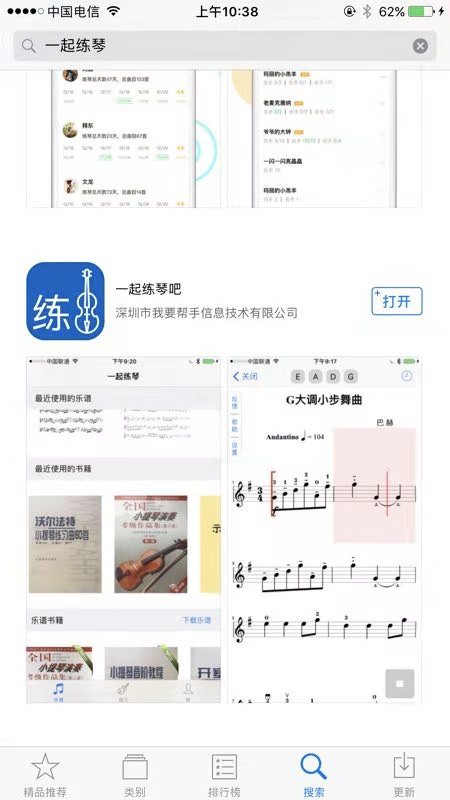
We were still working out of that room when we went to a musical instrument trade show in Guangzhou for the first time in the spring of 2018.
We couldn’t bring ourselves to spend money on a booth, so we borrowed a corner of a friend’s booth. We stood beside the aisle all day with our tablets. By the end, our voices were hoarse and our eyes were still bright.
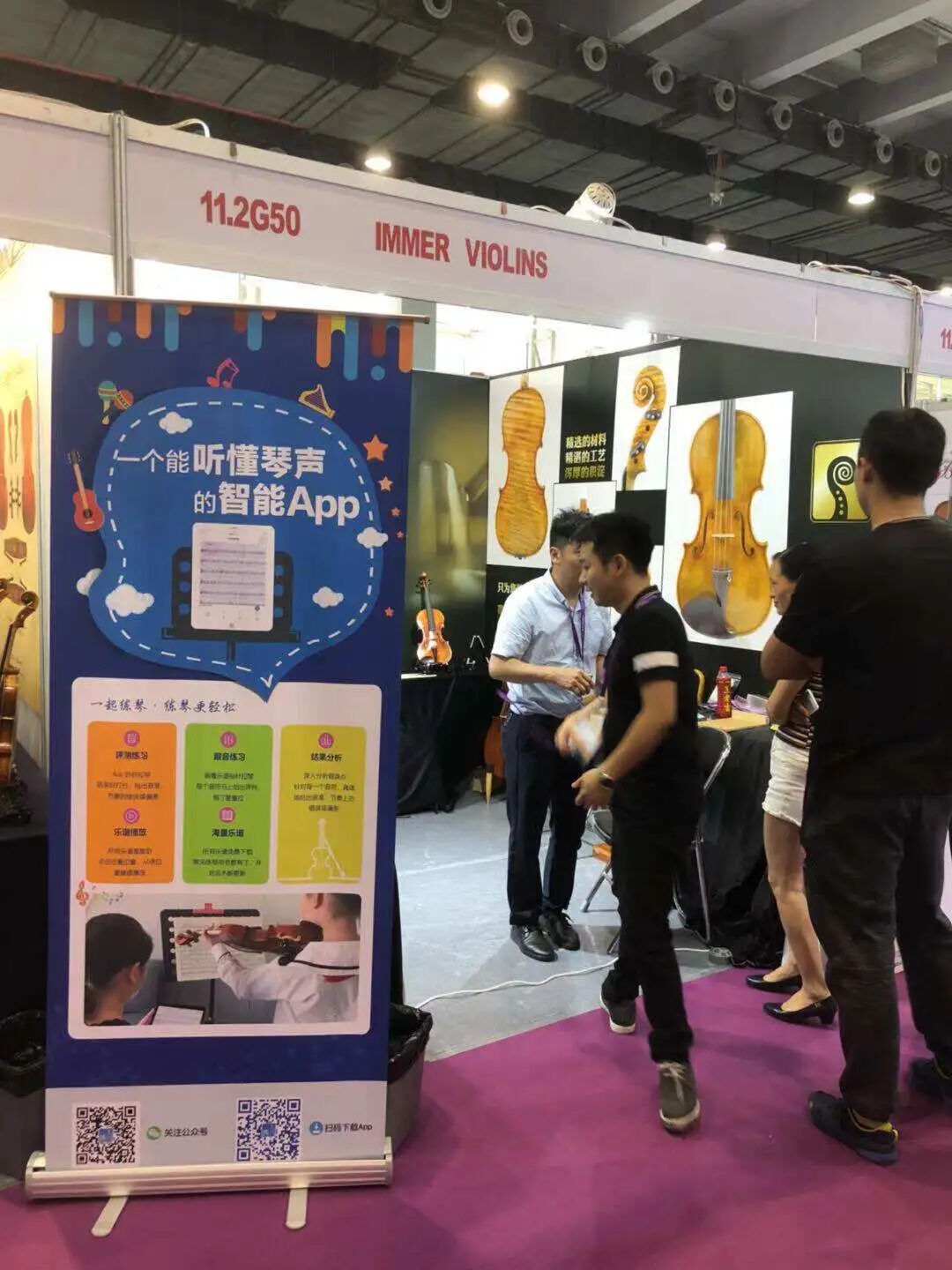
Later, we went to a musical instrument trade show in Shanghai, where we had a bigger booth of our own. Many Violy users stopped by to support us.
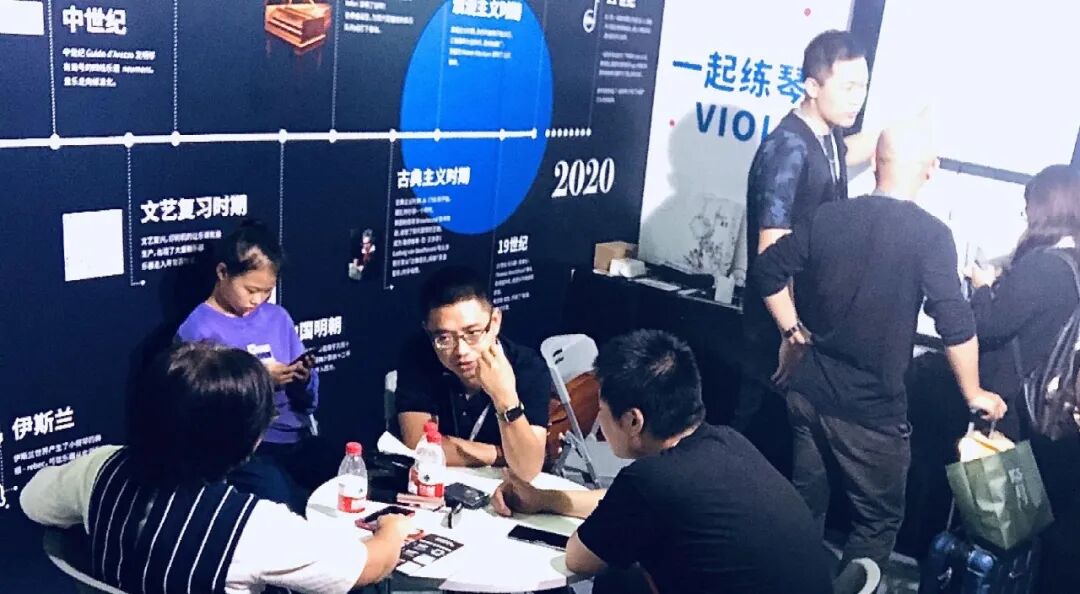
(Our team in Shanghai in 2019)
We later moved into a bigger office and found more people who shared our goals. Violy also found its footing internationally.
Looking back, it feels as though young musicians and their parents have been moving us forward the whole way.
Mothers in our WeChat group asked, “My younger child is learning piano. When will they be able to use the app?” and “It’s so hard for kids learning cello or flute to find a piano accompanist. Can you help?” We worked through the challenges of recognizing the sound of each instrument. We started with the violin and gradually added cello, viola, wind instruments, and piano. For students who didn’t have an accompanist nearby, we recorded backing tracks, made recordings of the music sung aloud, and prepared demonstrations.
The winter of 2020 is the one we remember most vividly.
COVID-19 hit suddenly. Practice rooms shut down, and countless children preparing for graded music exams and school entrance exams were stuck at home. Ordinary video calling apps would filter out high notes as background noise, frustrating teachers and students on both sides of the screen. The team worked around the clock over the Lunar New Year holiday. On February 15, 2020, we launched video calling in China with audio designed to preserve the sound of musical instruments.
That winter, music from all over China came through our servers day and night. In our recollection, every music conservatory in China was using the app then.
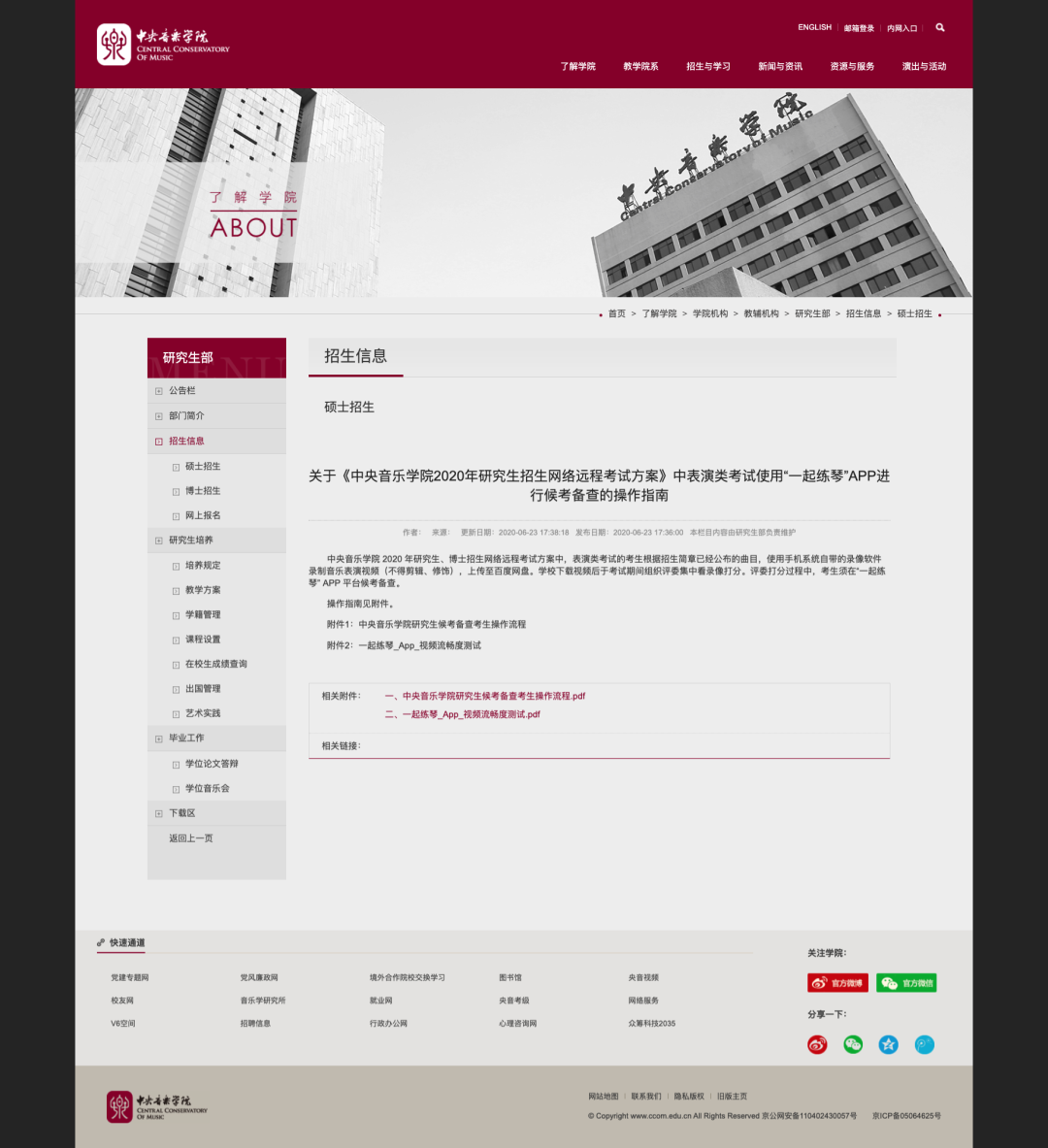
In June 2020, the Central Conservatory of Music officially designated Violy for live spot checks during remote performance exams for master’s and doctoral admissions. Central Conservatory of Music admissions notice
We heard about young musicians setting up phones in their living rooms and playing the final note of an exam that meant so much to them. For the first time, it really sank in that the code we’d written in that 10-square-meter room could help people hold on to something they cared about through a difficult time.
The hardest part of the past ten years was staying around after we’d built the app.
Parents who’ve been through years of music lessons with their children will remember the industry’s ups and downs in China.
At the height of the boom, funding announcements and ads were everywhere. When the boom ended, many once-familiar companies vanished overnight, leaving parents holding bundles of prepaid lessons and getting no answer when they tried to get their money back.
We watched many of our peers in online music education grow rapidly, then collapse just as fast.
After that, a tentative question kept coming up in customer support chats and livestreams.
“I’d like to buy a two-year membership for my child … are you going to be around?”
Our hearts sank a little every time we read it. We understood the worry behind the question. The few hundred yuan mattered, and so did the fear that the support their child had finally grown used to might disappear, leaving them feeling they’d let their child down again.
Luckily, we’d chosen the slow, seemingly foolish route from the start.
Over the decade, we kept away from extravagant ad spending, sales pitches that played on parents’ fears, and expansion we couldn’t sustain.
By the fall of 2021, as teachers and parents told others about us, we’d quietly grown enough to fund our own operations and earn a healthy profit. One step at a time, we’d become long-distance runners in the industry.
Learning an instrument takes patience. A child may have to work through a concerto hundreds or thousands of times before they can play it confidently. How could we build a product to support that work by chasing shortcuts and quick money?
Here we are a decade in, still doing work that looks slow from the outside.
In 2026, we released automatic accompaniment for violin in China after a long period of development.
With a backing track, children used to have to chase a rigid beat. If they lost their place, it was hard to recover. With the new feature, the accompaniment follows when they play a little faster. If they hesitate for half a beat at a tricky position shift, it waits right there for them.
While we were building it, someone on the team asked a question that moved us: “Isn’t good accompaniment supposed to wait for the child?”
That’s what we’ve wanted to offer all these years. Take your time and play at your own pace. We’ll be here when you’re ready.
With what we’d learned over the decade, in the spring of 2025 we also started Wonder Piano for younger children just getting their hands on the black and white keys.
Violy helps older children through the dull stretches of practice, and Wonder Piano nurtures beginners’ first spark of curiosity. Through both, we’ve always hoped to bring fewer tears and more joy to families making music at home.
It’s exactly 7:30 in the evening as we write this.
For countless families, it’s one of the busiest and gentlest moments of the day.
Maybe your child is standing in the warm light right now, taking a deep breath before playing the first note of the evening.
Maybe you’re on the sofa outside the room, listening quietly as the music begins to flow, more at ease now that you’re no longer listening for every wrong note.
Or perhaps a child who was among the first to use Violy almost a decade ago has packed their bags and gone off to a university far from home. The old instrument case in the corner rarely gets opened now, but all those evenings they gritted their teeth and kept playing gave them confidence for the hard things they’d face later.
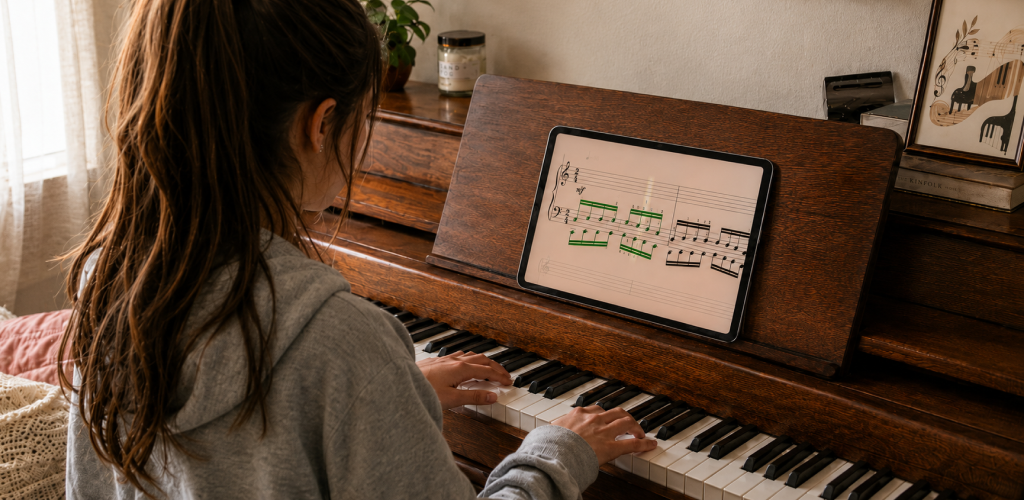
In that little 10-square-meter room nearly a decade ago, we never dared to imagine how far we’d come. Now, a decade on, when that longtime member of our WeChat group typed “I’ve known you for ten years” during the livestream, it suddenly felt like the best answer we could have hoped for after all those late nights, all our awkward first attempts, and all the times we kept working because we knew we could do better.
Thank you for trusting us with your children’s after-school practice nearly ten years ago, when we were just starting out. Thank you to every child who worked up a sweat at a music stand and kept going. Thank you to every parent who knew little about music and still did everything they could, gently, to protect their child’s love for it. And thank you to every teacher who recommended us to one group of students after another.
There’s a long road ahead when you learn an instrument. For our first ten years, thank you for growing with us. For the next ten, whenever you open your sheet music again, we’ll be here.
As we marked our anniversary in November 2026, we were also planning events for the Violy community in China that December and invited families to take part.