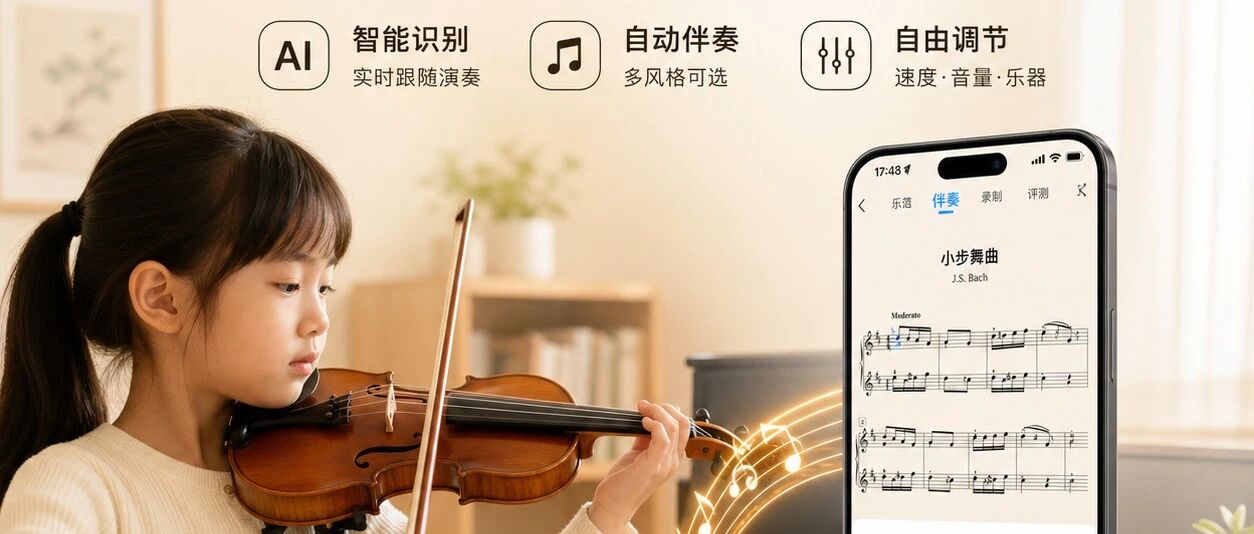
Both Apple and Android Users Can Use It!
This feature announcement concerns Violy’s China market. The availability, app versions, membership requirements, and support arrangements described below reflect the offering at the time of the announcement, rather than current Global availability or membership benefits.
With this update, we wanted to address a problem that many families with children learning the violin encounter:
During everyday practice, children often play the melody on their own.
But in lessons, graded music exams, competitions, and performances, many pieces require them to play with piano accompaniment.
Without enough ensemble practice beforehand, children can encounter these difficulties when it is time to perform:
- An unsteady rhythm;
- Coming in at the wrong time;
- Feeling nervous when they hear the piano accompaniment;
- Playing independently instead of staying together with the accompaniment.
That is why we developed AI automatic accompaniment.
It does more than play a fixed recording of piano accompaniment. Like a real piano accompanist, it listens to the child’s playing and follows along in real time.
Previously, accompaniment was more like this:
“The piano accompaniment plays at its own tempo, and the child has to work hard to keep up.”
The new AI automatic accompaniment is more like this:
“When the child plays a little faster, the piano accompaniment speeds up too; when the child plays a little slower, the piano accompaniment slows down too.”
In other words, AI identifies where the child is in the piece and the tempo they are playing at. It automatically adjusts the accompaniment’s timing to match the child’s performance in real time.
This is helpful for everyday practice.
When children practice at home, they can work on more than playing the right notes and rhythms: they can also become familiar with the feeling of playing together with a piano.
Especially when practicing exam pieces, competition repertoire, or concertos, children can become familiar with the piano accompaniment earlier, rather than discovering problems only when they finally rehearse with an accompanist.
It also makes things easier for parents.
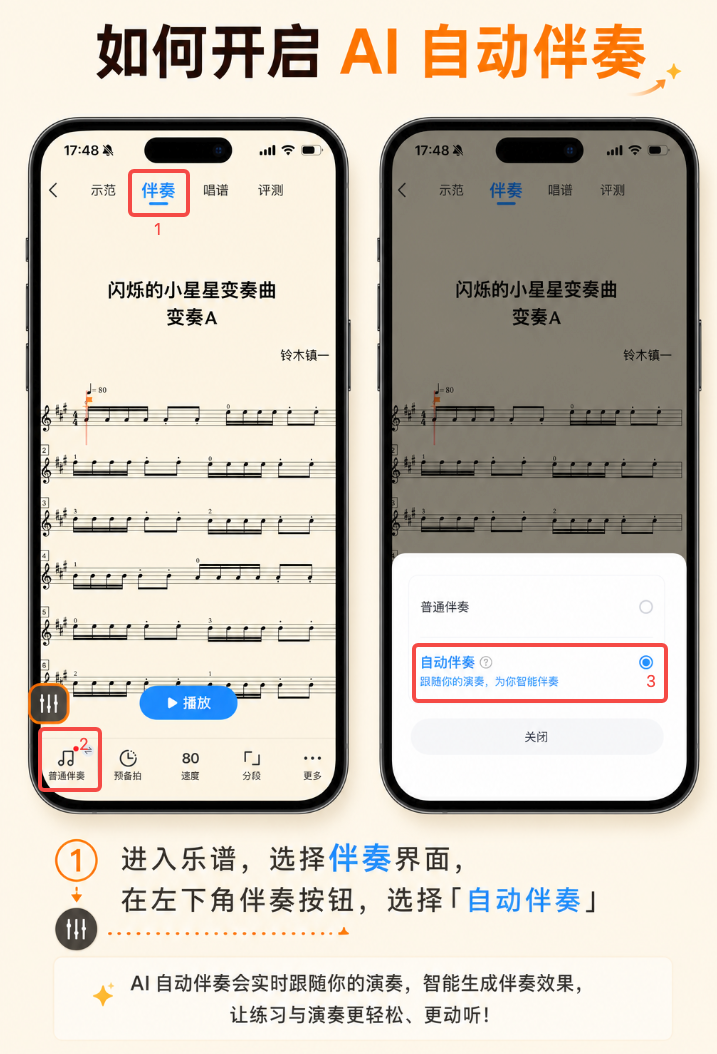
Previously, giving a child more opportunities to practice with piano accompaniment could mean arranging a teacher, finding a suitable time, and booking a place to rehearse.
With this update, families could simply open the Violy app and practice with accompaniment at home.
By practicing a little each day, children can gradually become more familiar with the accompaniment and find it easier to develop a steady sense of rhythm and confidence on stage.
At the time of the announcement, there were several points to note about AI automatic accompaniment:
First, an app update was required.
Apple users were asked to update the Violy app to version 13.18.0 or later; Android users were asked to update to version 13.19.0 or later.
HarmonyOS devices were not yet supported.
Second, this was a VIP membership feature.
An active VIP membership was required to use AI automatic accompaniment.
Third, automatic accompaniment was available only for the violin.
AI automatic accompaniment for other instruments was not yet supported.
Fourth, accompaniment was already available for most scores.
If a score a child was practicing did not yet have accompaniment, families were invited to contact Violy’s China-market customer service team. We would do our best to arrange for accompaniment to be added.
At the time of the original announcement, Violy described itself as having reached its tenth year since its founding in 2016.
Throughout these years, we have kept working toward one goal:
Making children’s practice more efficient, and giving parents less anxiety and more practical ways to support their children’s practice.
As a practice app trusted by families learning string instruments, we will continue improving the product and making the practice experience more professional and easier to use.
Thank you for your continued support.
Violy will keep supporting children as they practice well and make steady progress.